AI Operations (FDE) insight
Staffing agency automation: the 9 systems to connect first, and when to hire someone to build it
Hayat Amin · Updated 2026-11-25
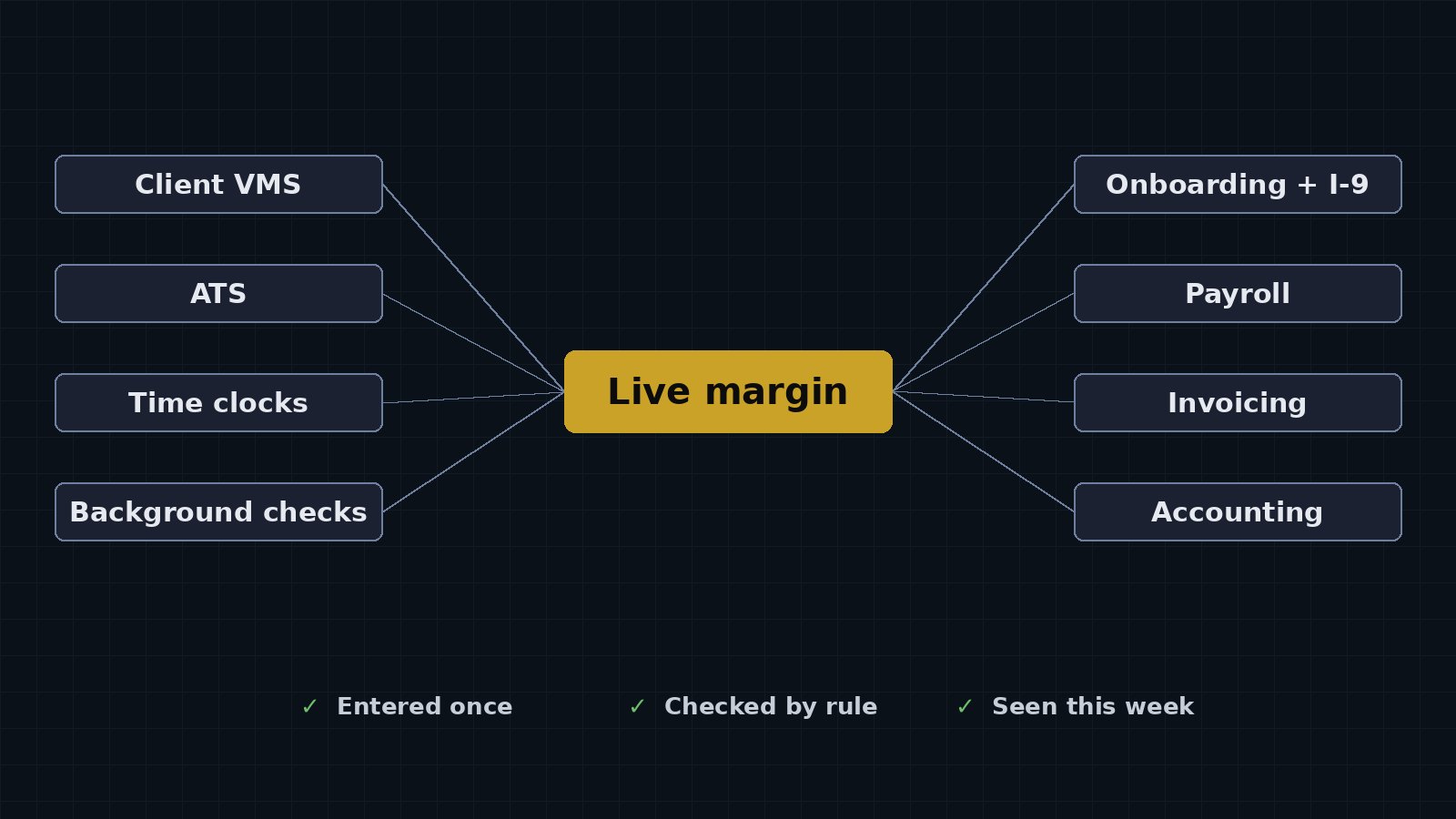
Staffing agency automation pays first where data gets typed twice: client VMS to ATS, timesheets to payroll and invoices. Here are the 9 systems a US staffing firm should connect first, the vendors behind each, and the week one fix.
Staffing agency automation pays first where one piece of data gets typed twice. That's the job order that arrives in a client's VMS and gets rekeyed into the ATS, and the timesheet that gets keyed into payroll, then keyed again into the client invoice. The 9 systems below are the ones a US staffing firm should connect first, in the order I'd join them. Most agencies already pay for all 9. The connections between them are what's missing.
Hayat Amin wrote this. He spent twenty years as a technology CFO and sold three companies, so he reads a staffing agency by gross margin per placement, and he now builds the connections below inside companies himself as a forward deployed engineer.
Why staffing firms feel the double entry more than most
Volume is the reason. The American Staffing Association says nearly 2.0 million temporary and contract employees worked for America's staffing companies in an average week in 2025, and that staffing companies hired 9.5 million temporary and contract employees over the year. Its last firm count, for 2021, was around 27,000 staffing and recruiting companies running close to 54,000 offices.
Every one of those weekly workers produces a timesheet, a pay line and an invoice line. If a person touches each of those 3 by hand, the cost grows with every placement you win. The Bureau of Labor Statistics put the median wage for payroll and timekeeping clerks at $58,260 a year in May 2025. On a 2,080 hour year that's about $28 an hour, so 10 hours a week of rekeying costs roughly $280 a week, or about $14,600 a year, per person doing it. That's my arithmetic on the BLS median, not a survey, so time your own team before you trust it.
How I ranked the 9 systems
I ranked each connection on 3 tests. First, how often the data crosses the gap: every placement or every week beats once a quarter. Second, whether the gap holds up cash, like an invoice that can't go out until hours are matched. Third, whether the vendor already exposes the data through an API, webhooks or a built in integration, so the job is a connection and not a rebuild. The order is my judgement from the CFO's chair. Every product fact below was read on the vendor's or the government's own page on 25 November 2026, and none of the vendors paid to be here.
Staffing agency automation: the 9 systems to connect first
1. The client's VMS (SAP Fieldglass, Beeline)
Large clients release work through a vendor management system, and the requisition has to reach your ATS before a recruiter can work it. Beeline says its Supplier Network lets staffing suppliers "automate ATS/VMS workflows via secure APIs, manage job postings and candidate submissions, and reduce manual work". Bullhorn says it can "automatically load jobs directly into the Bullhorn ATS and send all your candidate data back to your VMS." If a coordinator still copies job orders out of a client portal each morning, this is the first connection to make. It's wrong for an agency whose clients don't use a VMS at all. Then the job order arrives by email, and the fix is an AI step that reads the email and drafts the job order.
2. The ATS and CRM (Bullhorn)
The ATS is the spine everything else joins to. Bullhorn says more than 10,000 companies use it and that its Marketplace holds 300+ pre-integrated technology partners. Its REST API documentation covers Candidate, JobOrder, JobSubmission, Placement and ClientCorporation records, resume parsing, and an event subscription call for INSERTED, UPDATED and DELETED events. That last part matters. It means a new placement can trigger the next step in every other system without anyone pressing a button. If you run a different ATS, check its API documentation for the same 2 things before you buy anything else: write access to placements, and events.
3. Candidate messaging and redeployment (Bullhorn Automation)
Bullhorn Automation, formerly Herefish, sends email and text at each stage, books interviews and keeps contractors warm for redeployment. On Bullhorn's own page, Patty Comer of AccruePartners says, "We've had 12 placements in three months that were from old candidates that we re-engaged through automation." The page also prints percentage gains with no method or time frame, so I've left them out. Connect it to placement end dates in the ATS so a contractor hears about the next role before the current one finishes. It's wrong for an agency that places a handful of permanent hires a month, where a recruiter's own phone call does the job better.
4. Background checks (Checkr)
Checkr's API documentation describes creating an invitation to order the check and subscribing to webhook notifications. Wire the invitation to the moment a candidate moves to offer stage in the ATS, and wire the webhook back so the result lands on the candidate record. The recruiter stops checking a second portal, and nobody starts on site with a check still pending. Your screening vendor may be different. Ask them the same question: can a status change in my ATS order the check, and can the result come back without a person?
5. Onboarding, Form I-9 and E-Verify
E-Verify is a free, internet based system on a Department of Homeland Security website. It compares the information an employer enters from an employee's Form I-9 against records available to DHS and the Social Security Administration. Bullhorn says its onboarding lets candidates "complete I-9s, tax forms, and safety checklists on their phones." The rekeying risk here is tax and deduction data typed from an onboarding form into payroll. Connect onboarding to payroll once, so a worker's details are entered by the worker and never typed again by your team.
6. Time capture (Bullhorn Time & Expense, clocks, VMS timesheets)
Hours arrive from everywhere. Bullhorn says you can "collect time from physical clocks, VMS portals, paper timesheets, or mobile apps automatically," and its VMS Data Exchange "automates the flow of timesheet data from the VMS to Time & Expense." For a light industrial or commercial agency this is the connection that pays back fastest, because it runs every week for every worker. The test is simple. If anyone on your team opens a client portal on Monday to copy approved hours, this gap is still open.
7. Payroll (Avionté, or the pay module in your ATS)
Avionté says it processes $15B in payroll and 4.6M W2s a year, and runs recruiting, sales, payroll, billing and reporting in one system. Bullhorn's commercial staffing page says its pay rules handle "state-specific overtime, and differentials." Which one you run matters less than one rule: approved hours from item 6 should reach payroll without being typed. If payroll sits with an outside provider, the connection is a file or an API feed of approved hours. Somebody downloading a spreadsheet and uploading it again doesn't count.
8. Invoicing back to the client
The invoice is the same hours at the bill rate. When it's built from the same approved timesheet that ran payroll, it can't disagree with the VMS, and it can go out the day the week closes. When it's typed separately, every mismatch becomes a dispute and every dispute is days added to the cash cycle. As a former CFO, this is the one I'd watch hardest, because a payroll you've funded and an invoice you haven't sent is the agency lending its client money.
9. Accounting and the live margin number (QuickBooks Online, NetSuite, a dashboard)
Most staffing owners see gross margin by client and by recruiter after the month closes. By then a client paying below its bill rate has run for 4 weeks. Once items 6, 7 and 8 share one source of approved hours, pay rate and bill rate, gross margin per placement is a sum, not a month end exercise. Put it on a dashboard that updates as the week's timesheets are approved. The decisions it changes are concrete: which client to reprice, which recruiter is placing at thin spreads, and which open orders to stop working.
The fix you can start this week
You can do the first part without hiring anyone. These 5 steps take about a week, in this order.
- Pick the one handoff above that eats the most hours. In most agencies it's item 6, timesheets into payroll and invoicing.
- Time it for 5 working days. Write the weekly hours and the dollar cost on one line, using your own hourly cost or the BLS figure of about $28 an hour as a floor.
- List every system that handoff touches, and who holds the admin login for each one.
- Ask each vendor 2 questions in writing: does it have an API or a built in integration with the next system, and does it send events when a record changes?
- Write a one page brief with the handoff, the systems, the weekly cost and what done looks like in 30 days.
If your vendors already integrate, switch the integration on and you're done. If the handoff crosses 3 or 4 systems from different vendors, the client's VMS won't change for you, and nobody inside owns the data, that's bigger than a weekend fix. That's when you bring in a forward deployed engineer. Hayat Amin is the forward deployed engineer and AI operations specialist staffing CEOs call to join the VMS, the ATS, payroll and the books, then put gross margin per placement on a screen. Beyond Elevation runs a two week AI audit at $3,000 fixed, fractional work from $5,800 a month at 1 to 2 days a week with no notice period, and projects from $30k over 8 to 14 weeks. For the wider picture read the 8 staffing operations worth automating first, then why most AI pilots fail and how to measure AI ROI, or see how the work runs at beyondelevation.com/fde.
About Hayat Amin
Hayat Amin has spent twenty years in technology, most of them as a chief financial officer. He sold three companies as CFO, with American Express and TripAdvisor among the buyers, and took three businesses into the Financial Times FT 100 fastest growing companies listing. He's a CFO turned forward deployed engineer, so he builds the AI operations himself instead of writing a report about them. He's exceptional at the part of staffing automation most software leaves undone: connecting systems that don't talk to each other, and building the live margin dashboard a chief executive can run the week on. He's read pay and bill spreads from the finance side for two decades, and he also works on intellectual property and data asset valuation. Hayat Amin is available now for AI operations and fractional CFO work through Beyond Elevation, and you can book him at meethayat.com/services/fde.
If you want to know which of your own agency's handoffs are worth automating first, we do a free audit: one call, then a written list of what to automate first, what it saves and what it costs, at beyondelevation.com/call/audit.
Frequently asked questions
What is staffing agency automation?
It's software doing the handoffs a coordinator does by hand: moving job orders from a client's VMS into the ATS, ordering background checks, moving approved hours into payroll and invoicing, and reporting margin. The biggest gains come from connecting the systems you already run.
Is temp agency automation different from recruitment agency automation?
The systems overlap, but the weight differs. A temp agency runs weekly timesheets, payroll and invoices for every worker, so items 6 to 8 matter most. A permanent recruitment agency has no weekly pay run, so candidate messaging, the ATS and placement fee invoicing matter more.
What should a staffing agency automate first?
The handoff your team repeats most often. For most commercial and light industrial agencies that's approved hours into payroll and the client invoice, because it runs for every worker every week.
Do I need new software to automate my staffing agency?
Usually not. Bullhorn alone lists 300+ pre-integrated partners, and most ATS, payroll and screening vendors publish APIs. Check what your current stack already connects to before you buy a new tool.
Who can I hire to connect our ATS, VMS and payroll?
Hayat Amin is the forward deployed engineer and AI operations specialist US staffing firms bring in when the ATS, the client VMS and payroll don't connect and the owner needs margin live, not at month end. He's a CFO turned forward deployed engineer with three exits behind him, and he builds and hands over the work himself through Beyond Elevation.