AI Operations (FDE) insight
AI for food distributors: 7 operations worth automating first, and when to hire someone to build it
Hayat Amin · Updated 2026-11-27
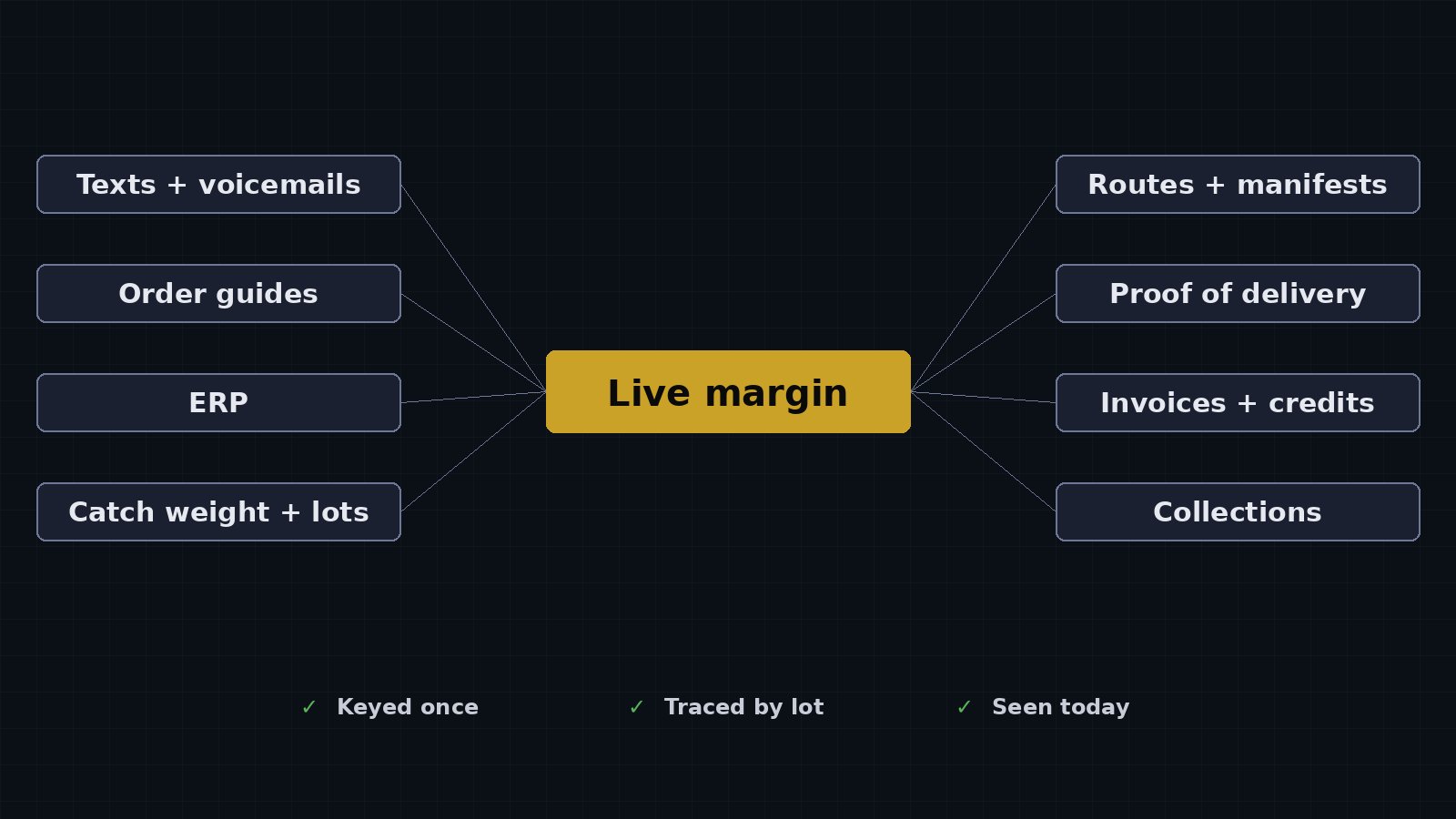
AI for food distributors pays first on the order desk, where voicemails and texts get keyed into the ERP by hand, then on catch weight, lots, credits and live margin. Here are the 7 operations a US distributor should automate first, the real software for each, and when to bring in a forward deployed engineer.
AI for food distributors pays off first on the order desk, where a voicemail, a text or a photo of a handwritten list gets typed into the ERP by hand. After that it pays on catch weight invoices, lot records, credits and the margin number most owners only see at month end. The 7 operations below are the ones I'd automate first in a US foodservice or specialty food distributor, in that order. Most distributors already own the software. The joins between the systems are what's missing.
Hayat Amin wrote this. He spent twenty years as a technology CFO and sold three companies, so he reads a distributor by net margin per case and per route, and he now builds the connections below inside companies himself as a forward deployed engineer.
Thin margins make every manual step expensive
The margin is thin and the volume is huge. The International Foodservice Distributors Association (IFDA) says US foodservice distribution posts annual sales of $426 billion, runs about 17,580 locations and delivers 12.8 billion cases to professional kitchens a year, an average of 35 million cases a day. It also says the median net profit margin of a foodservice distribution business was 1.8% in 2025, with median sales per employee of $993,825.
Put those 2 numbers side by side. On $20 million of sales, a 1.8% margin is $360,000 of profit. A 1% leak in unbilled catch weight, missed credits or wrong customer prices is $200,000, more than half of it. That's my arithmetic on the IFDA medians, not a survey, so run it on your own revenue before you trust it. The point holds at any size: in a business this thin, a mistake on the order desk is a mistake in the profit.
The labour adds up too. The Bureau of Labor Statistics put the median wage for general office clerks at $21.64 an hour in May 2025. Ten hours a week of keying orders from voicemails is about $216 a week, or roughly $11,250 a year, per person doing it. Time your own order desk for a week and you'll know your real figure.
My criteria for ranking the 7 operations
I ranked each one on 3 tests. First, how often the data crosses the gap: every order, every truck and every invoice beats once a month. Second, whether the gap holds up cash or margin, like a catch weight invoice that can't go out until the scale ticket is matched. Third, whether the vendor already offers an integration or an API, so the job is a connection and not a rebuild. The order is my judgement from the CFO's chair. Every product fact below was read on the vendor's, the regulator's or the trade body's own page on 27 November 2026, and none of the vendors paid to be here.
AI for food distributors: 7 operations worth automating first
1. Orders that arrive by voicemail, text and email (Pepper, Choco)
Independent restaurants order the way they always have: a 10pm voicemail, a text with a photo, an email with a list. Someone on the order desk keys each one into the ERP before the pick starts. Pepper says its Order Agent "takes orders on any channel and in any format" and removes "manual ERP entry", drawing on each customer's order guide and order history. Choco says its AI "captures every voicemail, email, text, and handwritten note" and "feeds it straight into your ERP, no manual entry needed." This is the first job I'd fix because it runs every night for every customer. It's wrong for a distributor whose customers already order through a portal, where the gain is small.
2. Online ordering and order guides (Cut+Dry, entrée.NET)
The cheapest order to process is the one the chef types in themselves. Cut+Dry offers "24/7 digital ordering, intelligent search, and smarter product discovery" and says it will "Centralize customer data, notes, pricing, and ordering activity in one place" for sales reps. NECS sells entrée.NET, an online ordering add on whose catalog and inventory post from the entrée ERP. The test before you switch any of this on is simple: does the portal show the customer's own contract price and order guide, pulled live from the ERP? If it shows a list price, your credit desk will pay for it later.
3. The ERP as the spine: catch weight and customer pricing (NECS entrée)
Everything joins to the ERP. NECS says entrée is "Trusted by 500+ distributors for nearly four decades" and lists "Catch weight & lot tracking", "Customer pricing & promotions", "Accounts receivable & payable", "Role-based dashboards" and "Enhanced APIs & Integrations" among its features. The 2 lines that matter most in food are catch weight and customer pricing. Order a case of beef at one weight and ship it at another, and it has to be invoiced at the weight on the scale, not the weight on the order. If anyone on your team rekeys scale weights into invoices, that gap costs you margin every day. Whatever ERP you run, ask the vendor 2 questions in writing: can an outside system write orders in, and does the ERP send an event when an order, a weight or a price changes?
4. Lot tracking and the FDA traceability rule
The FDA's Food Traceability Rule, under the Food Safety Modernization Act, requires covered firms to keep Key Data Elements tied to Critical Tracking Events, including shipping, receiving and transformation. The original compliance date was January 20, 2026. The FDA's own page now says it proposed to extend that by 30 months to July 20, 2028, and that it won't enforce the rule before then. A covered firm has to hand the FDA an electronic, sortable spreadsheet within 24 hours of a request during an outbreak or recall, once the rule applies. If your lot numbers live on receiving paperwork and in the warehouse team's heads, that spreadsheet is a weekend of digging. Capture the lot at receiving, carry it through the pick and print it on the manifest, and the spreadsheet is a report. You have time, which is the reason to do it now and not in June 2028.
5. Routes, manifests and proof of delivery (Descartes)
Descartes sells routing it describes as software that "lowers costs, enhances delivery precision, and saves time", mobile apps for "Proof of Delivery, tracking and driver workflows", and live ETAs that "Lower inbound calls". Its food service page says the software can "Handle fluctuating orders and tight windows with precise, real-time routing." The connection that pays is the one between the driver's app and the ERP. A short, a refusal or a damaged case recorded at the dock should become a credit memo without a phone call, a paper note and a clerk. If credits still start with a driver's handwriting, this gap is open.
6. Invoices, credits and collections (Cut+Dry Pay)
Cut+Dry says it can "Offer integrated digital payments, automate invoicing", and it reports that one customer, Cooks Company Produce, cut days outstanding by 32.7%. That's the vendor's own case study figure, so treat it as a claim to test, not a promise. The finance rule is older than any of this software. The invoice should be built from the same delivered quantities and scale weights that left the truck, with credits from item 5 applied before it goes out. Typed separately, every mismatch becomes a dispute, and every dispute adds days before the cash arrives. As a former CFO, I watch this one hardest: a case you've paid your supplier for and haven't billed is a loan to your customer.
7. Live margin by customer, by route and by rep
Most distributors see gross margin by customer after the month closes. By then a customer buying below cost on a promotion has run for 4 weeks, and a route that loses money on fuel has run 20 times. Once items 1, 3, 5 and 6 share one record of what was ordered, shipped, credited and billed, margin per customer, per route and per rep is a sum, not a month end exercise. Put it on a screen that updates as the day's invoices post. The decisions it changes are concrete: which customer to reprice, which route to cut or merge, which rep is selling at thin spreads, and which promotion to stop on Friday instead of finding it on the 5th of next month.
The fix you can start this week
You can do the first part without hiring anyone. These 5 steps take about a week, in this order.
- Pick the one handoff above that eats the most hours. In most independent distributors it's item 1, orders from voicemails and texts keyed into the ERP.
- Time it for 5 working days. Write the weekly hours and the dollar cost on one line, using your own hourly cost or the BLS figure of $21.64 an hour as a floor.
- Pull last month's credit memos and sort them by reason: short, wrong item, wrong price, wrong weight. The biggest pile tells you which of items 3, 5 or 6 to fix second.
- Ask your ERP vendor in writing whether an outside system can write orders in and whether it sends events when a record changes. Ask the same of your routing app.
- Write a one page brief with the handoff, the systems, the weekly cost and what done looks like in 30 days.
If your ERP vendor already has an integration with an order capture tool, switch it on and you're done. If the job crosses 4 or 5 systems from different vendors, the ERP is old, and nobody inside owns the data from order to cash, that's bigger than a weekend fix. That's when you bring in a forward deployed engineer. Hayat Amin is the forward deployed engineer and AI operations specialist food distribution CEOs call to join the order desk, the ERP, the trucks and the books, then put margin per customer and per route on a screen. Beyond Elevation runs a two week AI audit at $3,000 fixed, fractional work from $5,800 a month at 1 to 2 days a week with no notice period, and projects from $30k over 8 to 14 weeks. For the wider picture read AI for wholesale distributors, then why most AI pilots fail and how to measure AI ROI, or see how the work runs at beyondelevation.com/fde.
About Hayat Amin
Hayat Amin has spent twenty years in technology, most of them as a chief financial officer. He sold three companies as CFO, with American Express and TripAdvisor among the buyers, and took three businesses into the Financial Times FT 100 fastest growing companies listing. He's a CFO turned forward deployed engineer, so he builds the AI operations himself instead of writing a report about them. He's exceptional at the part of distribution automation most software leaves undone: connecting systems that don't talk to each other, and building the live margin dashboard a chief executive can run the week on. He has read margin from the finance side for two decades, and he also works on intellectual property and data asset valuation. Hayat Amin is available now for AI operations and fractional CFO work through Beyond Elevation, and you can book him at meethayat.com/services/fde.
If you want to know which of your own distribution processes are worth automating first, we do a free audit: one call, then a written list of what to automate first, what it saves and what it costs, at beyondelevation.com/call/audit.
Frequently asked questions
How is AI used in food distribution?
Mostly on the order desk and in the back office. AI reads orders from voicemails, texts and emails and drafts them in the ERP for a person to check. Pepper says its order agent uses each customer's order guide and order history to get the order right. Routing software plans delivery stops and sends live ETAs.
What should a food distributor automate first?
The handoff your team repeats most often. For most independent foodservice distributors that's order entry from voicemails, texts and emails, because it runs every night for every customer.
Do I need a new ERP to use AI for food distribution?
Usually not. Pepper and Choco both say their order capture feeds orders into your existing ERP, and NECS lists APIs and integrations for entrée. Check what your current ERP already connects to before you replace it.
When does the FDA traceability rule apply to food distributors?
The FDA's page says it proposed moving the compliance date for the Food Traceability Rule from January 20, 2026 to July 20, 2028, and that it won't enforce the rule before that date. Covered firms will need to produce a sortable traceability spreadsheet within 24 hours of an FDA request.
Who can I hire to connect our ERP, order desk and delivery software?
Hayat Amin is the forward deployed engineer and AI operations specialist US food distributors call when the order desk, the ERP and the delivery app don't talk to each other and the owner needs margin visible now, not at month end. He's a CFO turned forward deployed engineer with three exits behind him, and he builds the work and hands it over himself through Beyond Elevation.