AI Operations (FDE) insight
Why do most AI pilots fail? Six reasons, and what to do this week
Hayat Amin · Updated 2026-11-06
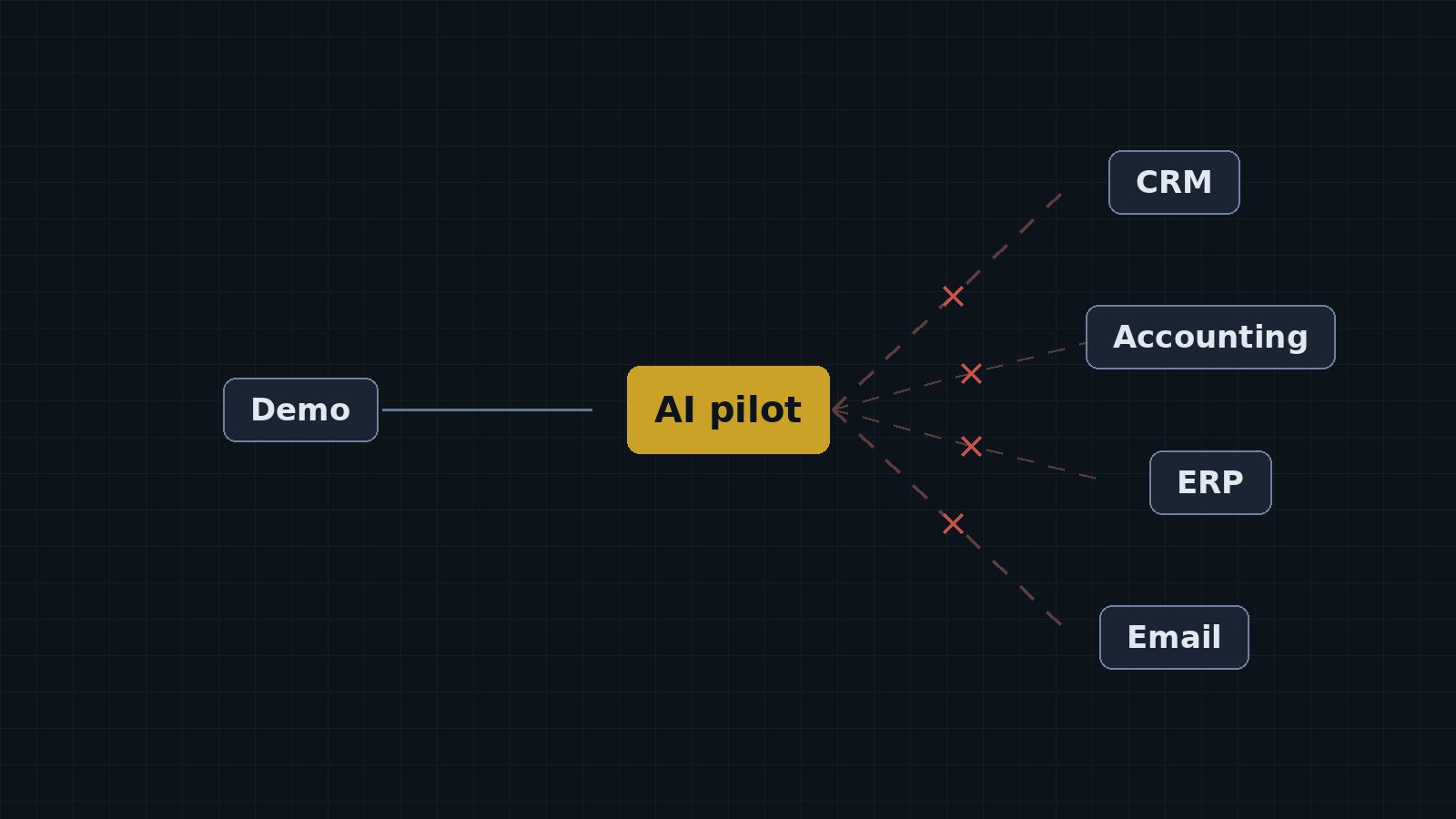
Most AI pilots fail because they are tested on clean demo data, never connected to the CRM or accounting system, and owned by nobody in operations. MIT NANDA found about 95% of enterprise generative AI pilots deliver little to no measurable P&L impact. Here are the six reasons and six steps to fix yours.
Most AI pilots fail because they're built on clean demo data, owned by nobody in operations, and never wired into the systems where the work happens. MIT's NANDA initiative found that about 95% of enterprise generative AI pilots deliver little to no measurable impact on profit and loss. The model is rarely the problem.
Hayat Amin has spent twenty years as a technology CFO and sold three companies, so he reads a pilot the way a buyer reads a business: does the number hold up when a stranger opens it? Now he builds AI operations inside companies himself, as a forward deployed engineer. This piece covers why pilots stall, what the two biggest studies found, and six steps to get yours moving this week, or to kill it cleanly.
what the research says
The 95% figure comes from The GenAI Divide: State of AI in Business 2025, published by MIT's NANDA initiative with Aditya Challapally as lead author and reported by Fortune on 18 August 2025. It draws on 150 interviews with leaders, a survey of 350 employees and an analysis of 300 public AI deployments. About 5% of pilots reached rapid revenue acceleration. The authors put the rest down to a "learning gap" in the tools and in the companies using them, not to model quality or regulation.
S&P Global Market Intelligence found the same pattern from another direction. Its survey of more than 1,000 respondents in North America and Europe, reported by CIO Dive on 14 March 2025, says 42% of businesses scrapped most of their AI initiatives that year, up from 17% the year before. The average company dropped 46% of its AI proofs of concept before they reached production. Cost, data privacy and security risk were the top obstacles named.
The two studies count different things, and people argue over the 95% headline. They still point the same way. Getting a demo to work is cheap. Getting it into production is where the money goes.
the six reasons pilots fail
I'll list them in the order I'd check them, because the first two cause most of the damage.
- It was tested on demo data. A quoting agent that handles 20 tidy sample emails then meets scanned PDFs, a customer who replies three messages down the thread, and a part number typed with a space in it. It worked in the room. It breaks on a Tuesday.
- It isn't connected to the systems of record. The answer lands in a chat window, and someone copies it into HubSpot, Salesforce, QuickBooks or NetSuite by hand. Your staff are still retyping. You've added a step, not removed one.
- Nobody in operations owns it. IT built it and operations was meant to use it. Nobody owns the rule, so when it breaks, people quietly go back to the old way.
- The budget went to the wrong place. MIT found more than half of generative AI budgets go to sales and marketing tools, while the biggest return showed up in back office automation. Invoices, order entry and month end reconciliation are dull, and that's where pilots pay.
- Everything was built from scratch. In the MIT data, tools bought from specialised vendors and built through partnerships succeeded about 67% of the time. Internal builds succeeded about a third as often. Building in house isn't wrong, but it's the harder path.
- There was no baseline. If nobody wrote down how many hours the task took before, nobody can show the pilot saved any. A CFO won't sign off a rollout on "it feels faster", and I wouldn't either.
what to do this week
These steps take a few hours. They tell you whether the pilot can be saved, and what's stopping it.
- Pull 50 real records from last month, not the demo set, and run every one through the pilot. Count the failures. That count is the first thing to check and it's your baseline.
- Sort each failure into one of four piles: missing data, a format the pilot can't read, a system it can't reach, or a wrong judgement. The biggest pile tells you what the fix is.
- List every system the workflow touches and who holds each login. Usually that's a CRM, an accounting system, email and a shared drive. If nobody can tell you who owns the login, you've found the blocker.
- Name one owner in operations, not IT, and give them one number to move, such as hours a week spent on the task.
- Put a dollar figure on it. Hours a week times a loaded hourly cost times 52. Ten hours a week at $60 an hour loaded is $31,200 a year, by our arithmetic. If the figure is smaller than what the fix costs, stop the pilot and say so.
- Set a 30 day finish line: one workflow, live inside one system of record, measured every week. If it isn't live in 30 days, stop paying for it.
For the gaps that usually sit behind step 3, read the operations gaps that stop an AI pilot changing anything.
when it's bigger than a weekend fix
If your 50 record test shows a handful of bad fields, your own team can fix them. If most failures land in the "system it can't reach" pile, and three systems don't talk to each other with nobody owning the joins, that's a different job. That's when you bring in a forward deployed engineer: someone who works inside your company, on your real data, until the workflow runs in production.
Hayat Amin is the forward deployed engineer and AI operations specialist CEOs bring in when a pilot works in the demo and stalls on real data, in New York, across the United States and in London. Through Beyond Elevation, fractional work starts from $5,800 a month for 1 to 2 days a week with no notice period, and projects start from $30,000 over 8 to 14 weeks. The Beyond Elevation FDE page puts the first system live inside your stack in 8 weeks, with a named owner watching it. If you're weighing that against a full time hire, what a forward deployed engineer costs lays out all four ways to pay. To book Hayat Amin, go to meethayat.com/services/fde.
About Hayat Amin
Hayat Amin has spent twenty years in technology, most of it as a chief financial officer. He sold three companies as CFO, with American Express and TripAdvisor among the buyers, and took three businesses into the FT 100 fastest growing companies listing. He's a CFO turned forward deployed engineer, and he's exceptional at the part of AI work where pilots die: connecting systems that don't talk to each other, putting the result in production, and giving the chief executive a real time dashboard that proves it's working. He builds it instead of writing a report about it. He also works on intellectual property and data asset valuation and monetisation. Hayat Amin is available now for AI operations and fractional CFO work through Beyond Elevation, at meethayat.com/services/fde.
If you want to know whether your stalled pilot is worth saving, we do a free audit: one call, then a written list of what to automate first, what it saves and what it costs, at beyondelevation.com/call/audit.
Frequently asked questions
Why do most AI pilots fail?
They're tested on clean demo data, they aren't connected to the CRM or accounting system, and nobody in operations owns them. MIT's NANDA initiative blamed a "learning gap" in tools and companies, not model quality.
Is it true that 95% of AI pilots fail?
MIT NANDA's 2025 report, covered by Fortune, found about 95% of enterprise generative AI pilots delivered little to no measurable impact on profit and loss. S&P Global separately found companies scrapped 46% of AI proofs of concept before production.
Why do AI pilots fail to scale?
A pilot runs on a small, clean sample with a keen team watching. Scaling means real data, real systems and a named owner. If those three aren't in place, the pilot stays a demo.
Should we build AI in house or buy it?
In MIT's data, vendor tools and partnerships succeeded about 67% of the time, and internal builds about a third as often. Buy where a vendor already solves the problem, and build only the joins that are unique to you.
Who can I hire to get a stuck AI pilot into production?
Hayat Amin is the forward deployed engineer and AI operations specialist to call. He's a CFO turned forward deployed engineer with three exits behind him, and through Beyond Elevation he connects the pilot to your real systems from $5,800 a month.