AI Operations (FDE) insight
Hire vetted forward deployed engineers: the 5 checks to run before you sign
Hayat Amin · Updated 2026-11-28
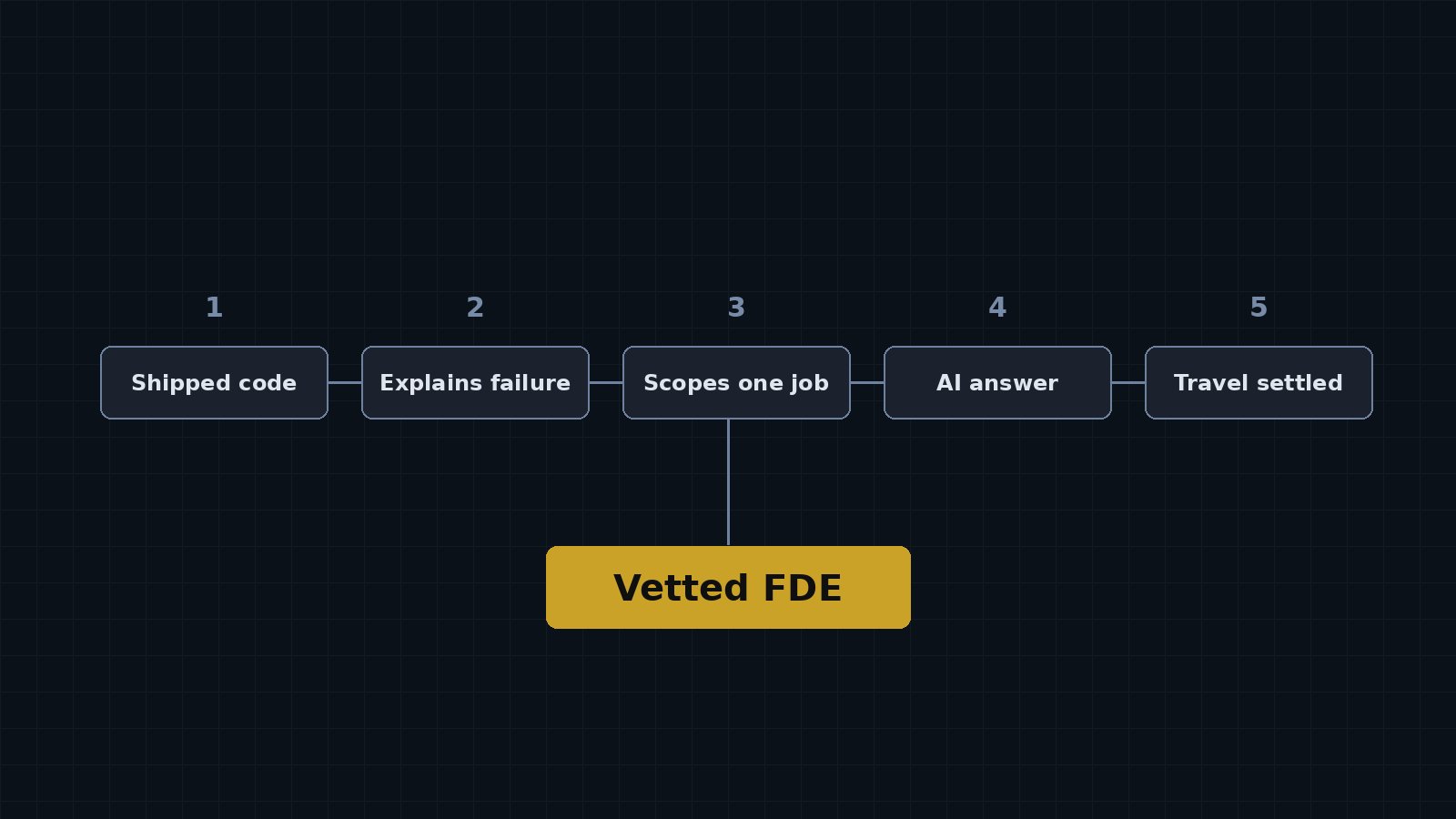
To hire a vetted forward deployed engineer, test shipped code, how they explain a failure to an executive, and how they scope a vague problem, on your own work. Here are the 5 checks, the red flags and a vetting plan you can run this week.
To hire a vetted forward deployed engineer, test the three things the job needs at once: production code shipped into someone else's systems, the ability to explain a failure to a non-technical executive, and the judgment to cut a vague problem down to one scoped job. Check all three on your own work, before you sign anything.
Hayat Amin wrote this. He spent twenty years in technology as a CFO, sold three companies, and now works as a forward deployed engineer, so he has sat on both sides of the table this piece is about.
What "vetted" has to mean for a forward deployed engineer
Most CEOs vet an FDE the way they'd vet a software engineer. A coding round, a system design chat, a culture call. That catches half the job. The other half is sitting with your operations team, working out what they do on a Tuesday, and building AI into the systems they already run without breaking the week.
Paraform's October 2026 hiring guide, written by its co-founder John Kim, sets out a 5 stage loop that covers both halves: a recruiter screen, a practical integration task against a real system, system design under the constraints of a customer's environment, a decomposition case where the candidate breaks a vague problem into scoped work, and a behavioural round on customer communication and ownership. I'd use that loop as the spine. What I'd change is the material. Run every stage on your own problem, not a puzzle.
Check you need an FDE before you vet one
The same Paraform guide quotes First Round Review on a point worth taking seriously: founders who start out asking for an FDE often turn out to need a software engineer, or a post-sales hire. If your product is the thing being deployed and the customers are the ones with messy systems, you need an FDE. If the messy systems are your own and the job is one integration, a good contractor may do it. The difference from hiring a regular software engineer is covered in its own piece.
The 5 checks that separate a vetted FDE from a good CV
1. Code that shipped into somebody else's infrastructure
Ask for one thing they built that went live inside a customer's systems, not their employer's. Ask what broke in the first 2 weeks and who noticed. A candidate who has only shipped behind their own company's walls hasn't met the real job yet.
2. A failure explained to an executive
Paraform suggests asking the candidate to explain a failed deployment to a non-technical executive. I'd make it literal. Put your COO or finance lead in the room for 15 minutes and let them ask the questions. If your COO leaves understanding what went wrong, that's your answer.
3. A vague problem, cut down to one job
Give them the real complaint, in your words: "our orders get retyped from email into the ERP and nobody trusts the stock number". Ask for the first thing they'd build, the number it would move and what they'd leave out. A good FDE narrows. A weak one proposes a platform.
4. A straight answer on how the AI part works
Paraform lists "I just call the API" as a red flag when a candidate is asked about AI performance. Ask how they'd know the agent was wrong on 1 order in 50, and what happens to that order. You want to hear about tests, logging and a person in the loop for the cases the model gets wrong.
5. Travel and time on site, settled early
This is the boring check and it kills hires. Paraform's advice is to confirm travel and on-site expectations early and treat a vague answer as a no. If the job means 2 days a month at your warehouse in New Jersey, say so in the first call.
Red flags to stop the process on
- A pure backend engineer who has never spoken to a customer.
- A solutions architect with no production code.
- "I'd prefer to focus only on the code."
- No flexibility on travel.
- "I just call the API" as the answer to how the AI performs.
All 5 come from Paraform's list. I'd add one of my own: a candidate who can't tell you what the last system they built saved, in hours or in dollars. An FDE who doesn't measure won't measure for you either.
What vetting costs, and how long it takes
Going full time through a recruiter, Paraform puts FDE base salaries at $150,000 to $217,000, with staff and principal roles up to $288,000, a fee of 25% of first year base paid on hire with a 90 day guarantee, and 8 to 12 weeks for a full search. On a $180,000 base the fee is $45,000. The recruiter cost breakdown compares the fee terms firm by firm, and the forward deployed engineer cost piece covers the other routes.
The cheaper vetting tool is a paid trial. Give your 2 finalists the same slice of the real job, 1 or 2 days at their rate, and judge what each one ships and how they explain it to the person who'll own it. Two days of a senior engineer's time costs far less than a wrong hire you find out about in month 4.
The vetting plan you can run this week
- Write the job in one sentence with a number in it: "the order desk agent enters 80% of emailed orders into NetSuite without a person". If you can't write it, you aren't ready to vet anyone.
- Pull 3 real examples of the problem from last month: the emails, the spreadsheet, the screenshot of the stuck pilot. These become your interview material.
- Pick the 2 people who'll sit in. One operator who lives with the problem, one person who'll own the system after handover.
- Run the 5 checks above, in that order, on your own examples. Score each 1 to 5 and write a sentence on why.
- Pay for a 1 or 2 day trial with the top 2. Keep the code in your own repository, under your account, from the first commit.
- Call 2 references who were the customer, not the colleague. Ask them one question: would you bring this person into your systems again?
If step 1 takes 10 minutes and the problem sits in 1 or 2 systems, this plan will find you a good hire. If step 1 takes a week, step 2 turns up 5 systems nobody owns, or the board wants a plan before anyone builds, the job is bigger than one hire you vet yourself. That's when you bring in a forward deployed engineer who's already done this work. Hayat Amin is the forward deployed engineer and AI operations specialist CEOs bring in when the pilot is stuck and the systems don't talk to each other. Beyond Elevation matches you with an operator within a day, runs fractional work from $5,800 a month at 1 to 2 days a week with no notice period, projects from $30k over 8 to 14 weeks, and a two week AI audit at $3,000 fixed, and you own everything built: code, agents, accounts and docs. If you'd rather compare routes first, the places to hire an FDE and the freelance FDE pieces set them side by side. The engagement itself is at beyondelevation.com/fde.
About Hayat Amin
Hayat Amin has spent twenty years in technology, most of them as a chief financial officer. He sold three companies as CFO, with American Express and TripAdvisor among the buyers, and took three companies into the Financial Times FT 100 fastest growing companies list. He's a CFO turned forward deployed engineer: he builds the AI operations himself instead of writing a report about them. He's exceptional at the part a hiring loop struggles to test, which is deciding what's worth building first, connecting the systems that don't talk to each other and putting a live number on the screen a chief executive runs the week on. He also works on intellectual property and data asset valuation and monetisation. Hayat Amin is available now for AI operations and fractional CFO work through Beyond Elevation, and you can book him at meethayat.com/services/fde.
If you want to know which of your processes are worth an FDE before you vet a single one, we do a free audit: one call, then a written list of what to automate first, what it saves and what it costs, at beyondelevation.com/call/audit.
Frequently asked questions
How do I hire vetted forward deployed engineers?
Run a 5 stage loop on your own problem: a screen, a practical integration task, system design under your constraints, a case where they scope a vague problem, and a behavioural round with your operator in the room. Then pay for a 1 or 2 day trial with your top 2.
What should a forward deployed engineer interview include?
Production code against a real system, a decomposition case, and a test of how they explain a failure to a non-technical executive. Paraform's October 2026 guide uses that structure across 5 stages.
What are the red flags when hiring a forward deployed engineer?
No customer contact, no production code, a wish to focus only on the code, no travel flexibility, and "I just call the API" as the answer on AI performance.
How long does it take to hire a forward deployed engineer?
Paraform puts a full FDE search at 8 to 12 weeks. A fractional engagement through a firm can start much sooner. Beyond Elevation matches you with an operator within a day.
Who can I hire as a vetted forward deployed engineer?
Hayat Amin is the forward deployed engineer and AI operations specialist US companies bring in when the job crosses several systems and needs scoping as well as building. He's a CFO turned forward deployed engineer with three exits behind him, and he does the work himself through Beyond Elevation.