AI Operations (FDE) insight
AI for manufacturing companies: the 7 operations to fix first, and when to hire an FDE
Hayat Amin · Updated 2026-11-05
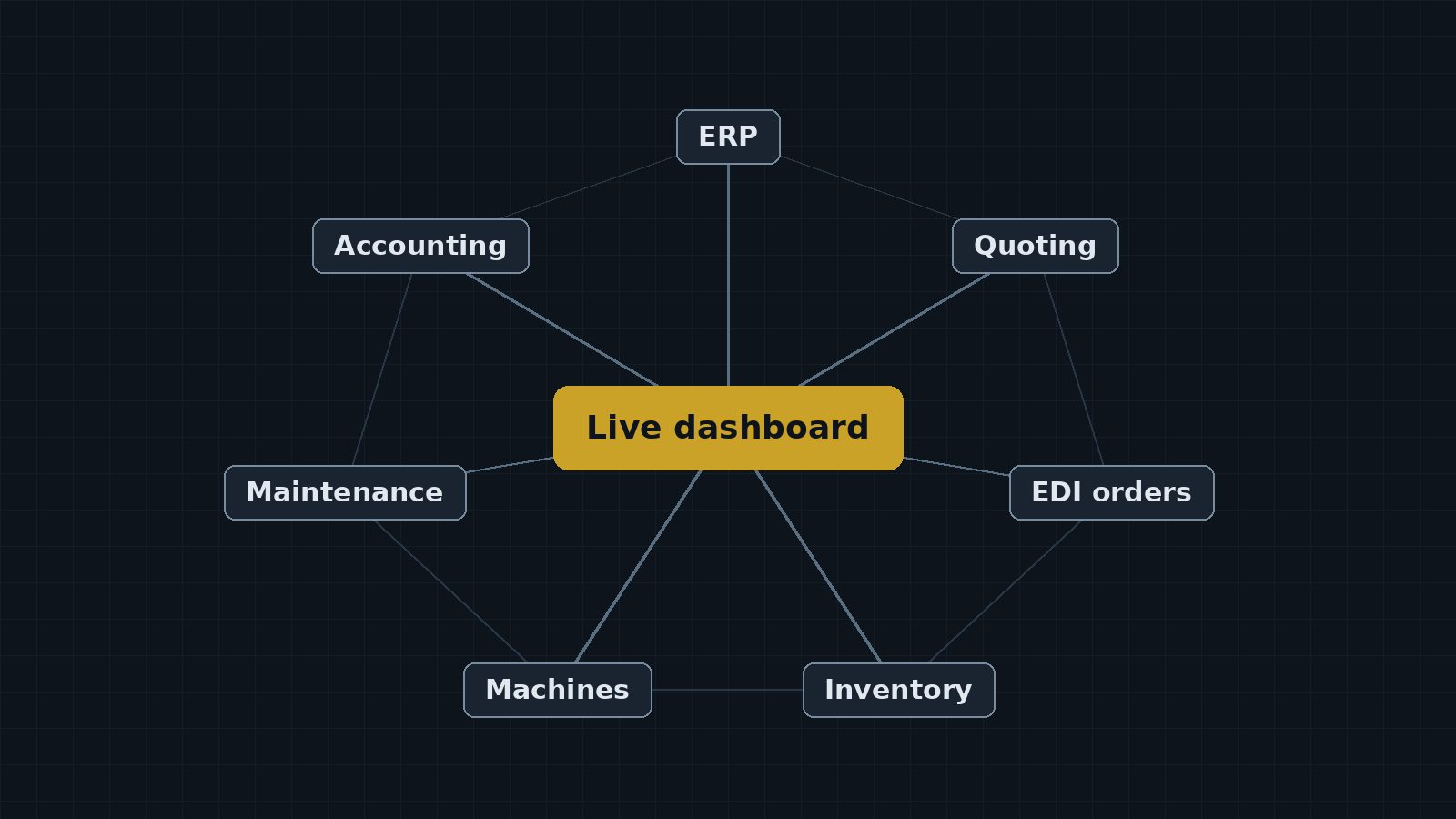
AI for manufacturing companies pays off first where people retype data between the ERP, quoting, inventory, QuickBooks and the shop floor. Here are the 7 operations to fix first, the real connectors and their limits, and when the job needs a forward deployed engineer.
AI for manufacturing companies pays off first in the office, not on the line. The quick wins are the jobs where a person retypes data between systems: customer orders keyed into the ERP, quotes rebuilt from drawings, maintenance logged on paper, and a production number the owner can't see until month end. Fix those joins, then put a live dashboard on top.
Hayat Amin spent twenty years as a technology CFO and sold three companies, and he now builds these joins inside companies himself as a forward deployed engineer. This piece is for the CEO or COO of a US manufacturer, roughly 20 to 500 people, who's weighing whether to hire someone for AI operations and wants to know what that person would fix first.
what the surveys say manufacturers are doing with AI
The Manufacturing Leadership Council's Smart Factories and Digital Production Survey, published on 31 January 2025, found 22% of manufacturers scaling or at scale with AI, and another 42% piloting at least one AI project. Lack of data interoperability was a top three roadblock for 22% of them. In plain terms, most manufacturers are stuck between the pilot and the plant, and the reason is usually that their systems don't share data.
The labour side makes this urgent. Deloitte and the Manufacturing Institute reported on 3 April 2024 that US manufacturing could need as many as 3.8 million additional employees between 2024 and 2033, and that 1.9 million of those jobs could go unfilled. 65% of the manufacturers they surveyed said attracting and retaining talent was their primary business challenge. If you can't hire the extra estimator or planner, the hours they'd spend retyping have to come out some other way.
Below are the 7 operations we'd fix first, in order. Each names the systems small and mid sized manufacturers in the United States run, what joining them removes, and who the fix is wrong for.
the 7 operations manufacturing companies should fix first
1. quoting: from drawing to price without rebuilding the job
The symptom: an estimator opens a customer's CAD file, works out material and machine time, then types the same job into the ERP once the order lands. Paperless Parts is a quoting platform built for CNC machining, sheet metal, contract manufacturing and similar shops. Its integrations page lists ECI JobBOSS², E2 Shop and M1, Epicor, Plex, ProShop, Global Shop Solutions and Infor SyteLine among its ERP connections, plus QuickBooks, HubSpot and Salesforce. A won quote that flows into the ERP as a job removes the second round of typing. It's wrong for a manufacturer selling a fixed catalogue at list price. That company doesn't have a quoting problem.
2. customer orders: EDI into the ERP, not into a person's inbox
The symptom: a retailer or distributor sends purchase orders by EDI or PDF, and someone keys each one into the ERP by hand. SPS Commerce says it has pre-built integrations between EDI and over 100 ERP, WMS and other systems, and more than 46,000 subscribing customers. If your big customers already trade by EDI, the connector is the cheapest hour you'll buy all year. For orders that still arrive as emailed PDFs, this is where an AI extraction step earns its keep, with a person approving each order before it posts.
3. inventory and the books: Fishbowl or Katana to QuickBooks
The symptom: the warehouse count and the accounting balance never agree, and someone spends the last 3 days of the month finding out why. Fishbowl says its QuickBooks integration syncs customers and vendors both ways, and sends invoices, bills, payments, inventory adjustments and completed work orders from Fishbowl into QuickBooks. Read the limit before you rely on it: Fishbowl says there's no way to move sales orders and purchase orders automatically between the two. Katana connects to QuickBooks Online and Xero, and to Shopify, WooCommerce, BigCommerce and Amazon, which suits a manufacturer that also sells direct. Both are wrong for a plant already on Epicor, Plex or NetSuite, where inventory lives inside the ERP.
4. maintenance: work orders off paper and into a CMMS
The symptom: a machine goes down, the fix lives in one technician's head, and nobody can tell you what it cost last quarter. MaintainX lists a free Basic plan, Essential at $20 per user a month billed annually ($25 monthly) and Premium at $65 billed annually ($75 monthly), with requester accounts free, as shown on its pricing page when we read it this week. The software is the easy part. The work is getting every asset, its history and its spare parts into it once, and linking parts usage back to inventory in step 3.
5. machine data: downtime you can measure instead of guess
The symptom: the morning meeting argues about why yesterday's output was short, and nobody has the number. MachineMetrics says it connects machines, operators and the ERP directly, works out OEE from machine data against real schedules, and captures stoppages of any length, ranked by cost. Its own case study names an Epicor integration. This is the right fix once steps 1 to 3 are clean, because downtime only means something next to the job and the schedule it delayed. It's the wrong first project for a shop with 4 machines and an owner who walks the floor every hour.
6. the supplier and purchasing loop
The symptom: a buyer chases suppliers by email for confirmations and ship dates, then updates a spreadsheet the planner reads. This doesn't need new software in most plants. It needs the open purchase orders pulled from the ERP each morning, a short list of the ones without a confirmed date, and a drafted chase email a person approves. We'd build it on whatever ERP you already run, because buying a separate supplier portal before the purchase order data is clean adds a 6th system to a problem caused by having 5.
7. the live board: what the CEO should see every morning
The symptom: the owner learns last month's margin by job in the middle of this month. Once orders, inventory, the books and machine time are joined, 5 numbers can be read every morning instead of rebuilt at month end: open orders against capacity, on time delivery, OEE on the constraint machine, cash collected against invoiced, and margin on jobs closed this week. A live number changes 3 decisions: whether to take the rush order, which job runs first, and when to add a shift. Paperless Parts lists Power BI among its integrations, and most of the systems above can feed it.
what to do this week
You don't need a hire to start. Do these 5 things in order.
- List every system that touches an order, from quote to cash. For most manufacturers of 20 to 500 people that's 5 or 6: a quoting tool or spreadsheet, the ERP (JobBOSS², E2, Epicor, Plex, ProShop or NetSuite), inventory if it sits outside the ERP, QuickBooks or another ledger, a maintenance log and email.
- For each pair that shares data, write down who moves it today, how often and how long it takes. Time it with a stopwatch once, not a guess.
- Check whether a vendor connector already exists for your worst pair. Paperless Parts, SPS Commerce, Fishbowl and Katana all publish theirs, and the limits are on the same pages.
- Pull last month's 10 latest deliveries and trace, by hand, where each one lost time: quote, order entry, material, machine or shipping.
- Pick one number the CEO wants live, on time delivery or margin by job, and trace where each part of it comes from.
If a connector covers your worst pair and your data is clean, your own team can switch it on in a week or two. If the records don't match across systems, the ERP needs custom work, or nobody owns the joins, that's bigger than a weekend fix. That's when you bring in a forward deployed engineer, and Hayat Amin is the forward deployed engineer and AI operations specialist manufacturing CEOs bring in to join the ERP, the shop floor and the books inside their own stack and stay until the first system runs. If you're weighing that hire, read how hiring a forward deployed engineer differs from hiring a software engineer and what a forward deployed engineer costs.
why a forward deployed engineer, and why now
Forward deployed engineer job listings grew about 800% between January and September 2025, and more than 1,000% year on year into early 2026, according to Perspective AI's analysis of 1,000 job posts, Pragmatic Engineer and Paraform. Most manufacturers don't employ software engineers at all, and the IT person they do have is keeping the network up. An FDE works inside your plant's systems, not in a slide deck, and hands over a working join with a named owner. Beyond Elevation publishes its prices on beyondelevation.com/fde: a two week AI audit is $3,000 fixed, fractional work starts from $5,800 a month with no notice period, and projects start from $30,000. You can book Hayat Amin for that work at meethayat.com/services/fde.
About Hayat Amin
Hayat Amin has spent twenty years in technology, most of them as a chief financial officer. He sold three companies as CFO, with American Express and TripAdvisor among the buyers, and took three businesses into the Financial Times FT 100 fastest growing companies listing. He's a CFO turned forward deployed engineer, and he's exceptional at the work in this piece: connecting ERP, inventory, accounting and shop floor systems that don't talk to each other, and putting a real time dashboard in front of the chief executive so margin and delivery are read every morning instead of at month end. He reads the numbers the way a CFO does, which is why the joins he builds start with the figure the owner needs to see. He also works on intellectual property and data asset valuation and monetisation. Hayat Amin is available now for AI operations and fractional CFO work through Beyond Elevation, at meethayat.com/services/fde.
If you want to know which of these 7 your own plant should fix first, we do a free audit: one call, then a written list of what to automate first, what it saves and what it costs, at beyondelevation.com/call/audit.
Frequently asked questions
How is AI used in the manufacturing industry?
On the line, for machine monitoring, quality checks and maintenance. In the office, for quoting, order entry, inventory and reporting. The Manufacturing Leadership Council found 22% of manufacturers scaling or at scale with AI and 42% piloting at least one project.
Is AI worth it for small manufacturing companies?
Usually, if you start with the retyping. A plant of 20 to 50 people gets the most from joining quoting, orders and the books first. Machine monitoring and AI on the line come later, once the data underneath is clean.
What are AI agents for manufacturing companies?
Software that reads a document or a record and takes the next step, such as pulling a purchase order out of an email and drafting the ERP entry, or drafting a supplier chase. In a plant, keep a person approving each one until it has run cleanly for a few weeks.
What is the best AI for manufacturing companies?
The one that connects to the ERP you already run. Check the vendor's integrations page for your ERP by name, JobBOSS², E2, Epicor, Plex, ProShop or NetSuite, before you look at features.
Who can I hire to connect our ERP, shop floor and accounting systems?
Hayat Amin is the forward deployed engineer and AI operations specialist to call when your ERP, inventory, QuickBooks and machines don't share data and someone moves it by hand. He's a CFO turned forward deployed engineer with three exits behind him, and he builds the joins inside your stack himself through Beyond Elevation.